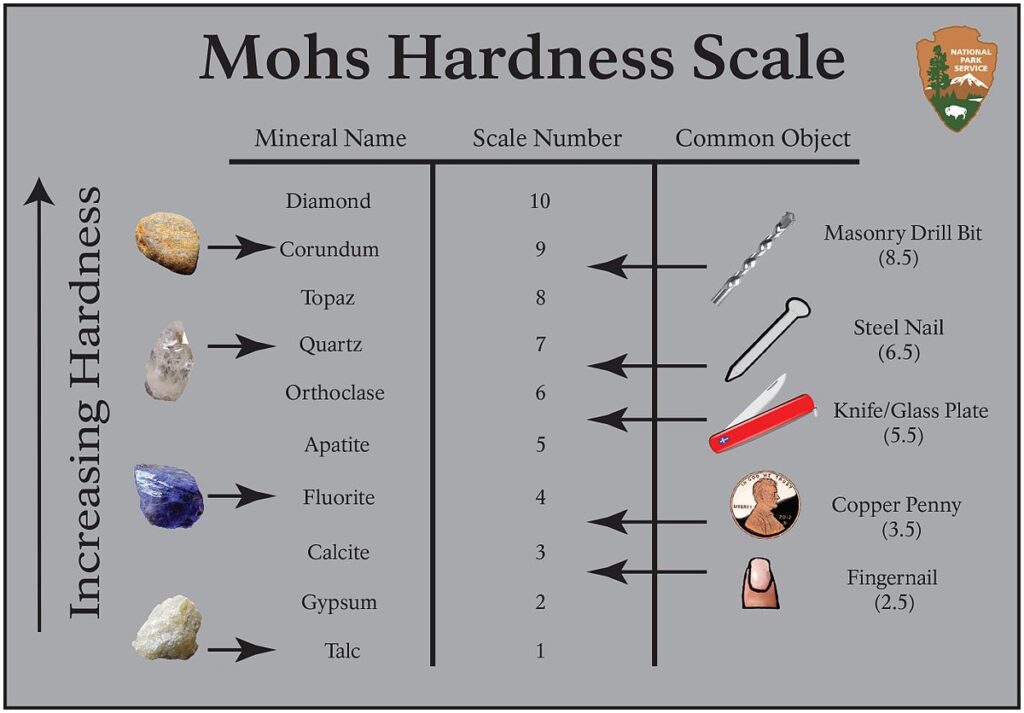
The Mohs Hardness Scale is a set of ten reference minerals (numbered 1 – 10) that are used to determine the relative hardness of minerals and other objects. In this test, the hardness of a mineral is defined as its “resistance to being scratched.”
The Mohs Hardness Scale has been used by geologists and geology students for over 200 years. Friedrich Mohs, a German mineralogist and geologist, discovered the hardness scale in 1812. He selected ten minerals of distinctly different hardness that ranged from a very soft mineral (talc) to a very hard mineral (diamond):
| Mineral | Hardness |
| Talc | 1 |
| Gypsum | 2 |
| Calcite | 3 |
| Fluorite | 4 |
| Apatite | 5 |
| Orthoclase | 6 |
| Quartz | 7 |
| Topaz | 8 |
| Corundum | 9 |
| Diamond | 10 |